The Artemis Program: Humanity’s Return to the Moon.
A comprehensive overview of NASA's Artemis Program, its ambitious goals to return humans to the lunar surface, establish a sustainable presence, and use the Moon as a crucial stepping stone for future exploration of Mars and beyond.
1. What is the Artemis Programme and What Are Its Goals?
Artemis Programme: Credit-NASA
The Artemis Programme is a human-spaceflight initiative led by NASA (United States) that aims to return astronauts to the Moon, establish a sustainable human presence there, and use that as a stepping stone for future exploration of Mars and beyond.
Origins & Reasoning
The programme formally launched in 2017. Its name comes from the Greek goddess Artemis (twin sister of Apollo), linking it symbolically to the earlier Apollo Program of the 1960s–70s. The reasoning behind it includes:
No human has landed on the Moon since Apollo 17 in 1972. The Artemis Programme seeks to change that.
The aim is more than a “one-off” landing. It is designed to set up a longer-term, repeatable human presence on and around the Moon (rather than three days and back).
The Moon is treated as a training ground for deeper space missions, including Mars. In other words: “Moon to Mars architecture.""
Key mission objectives include:
Landing the first woman and the first person of colour on the lunar surface.
Advancing technologies and science for lunar and deep‐space exploration.
Building collaborations with international and commercial partners.
Summary of Goals (Key Points)
Return humans to the Moon’s surface and stay (i.e., establish infrastructure, exploration, science).
Explore regions previously unvisited—especially the lunar South Pole, which may contain water ice and other resources.
Use Artemis missions as stepping stones for human missions to Mars and beyond.
Build and employ new infrastructure (rockets, spacecraft, lunar orbit station, landers, etc).
Engage commercial industry and international partners to broaden access and sustainability.
Artemis Mission Explained
2. Key Components of the Artemis Programme
The Artemis Programme comprises several major hardware and system components. Below are the key ones, with a bit of detail on each.
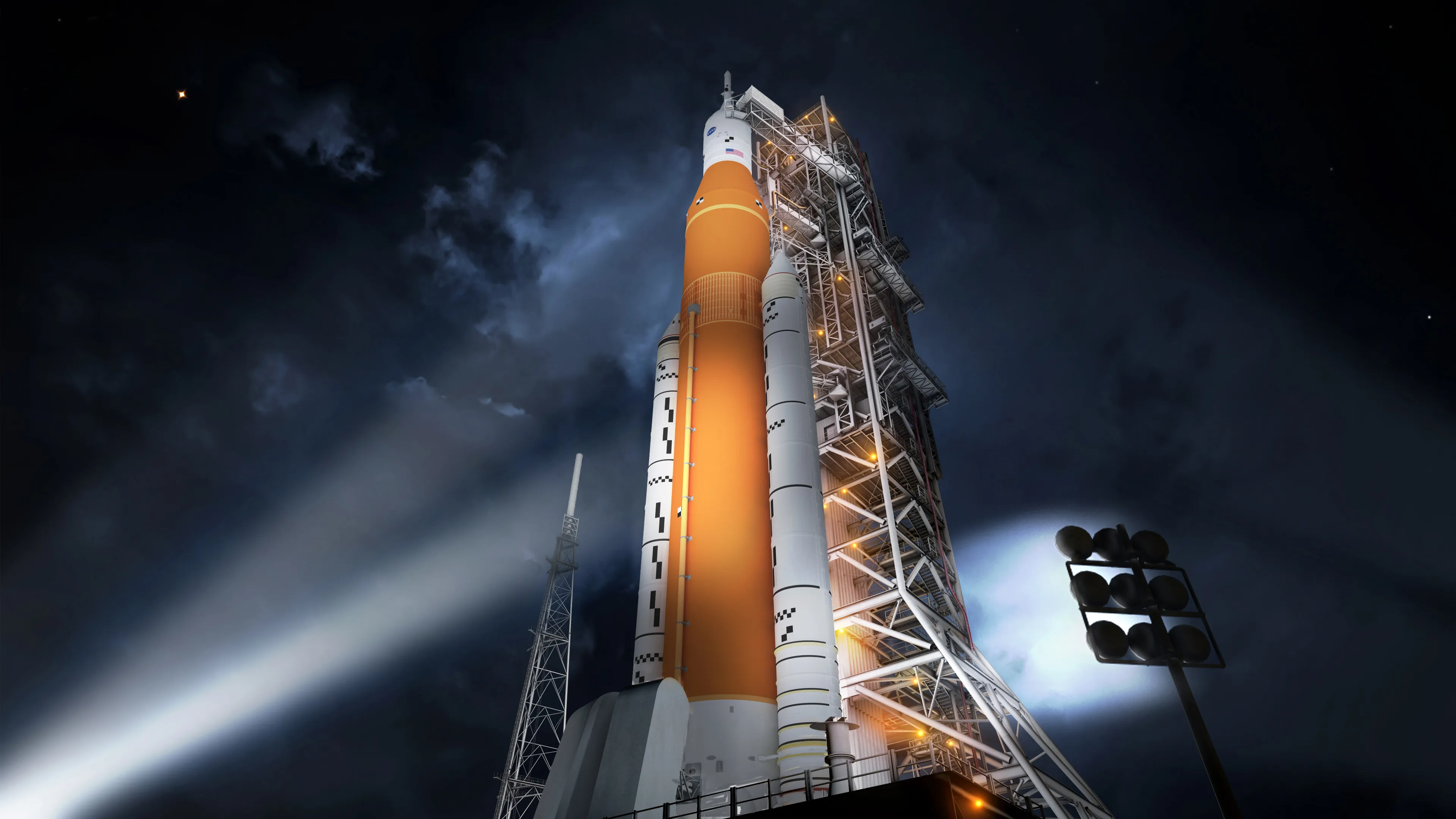
2.1 Space Launch System (SLS)
The SLS is NASA’s super-heavy-lift launch vehicle designed to carry the Orion spacecraft (crew module) and other payloads from Earth orbit to trans-lunar trajectories.
It uses a combination of heritage engines (RS-25) and solid-rocket boosters, along with a large core stage and upper stages. Various blocks/configurations are planned (Block 1, Block 1B, Block 2) to increase performance over time.
Role in Artemis: it lifts Orion (and other elements) out of Earth orbit, into lunar trajectories, making deep‐space human missions possible.
2.2 Orion Spacecraft (Crew Module + Service Module)
Orion is the spacecraft that carries human crews (or will) to lunar orbit (and beyond) and back to Earth.
It consists of a crew module (CM) and service module (SM). The service module is supplied by the European Space Agency (ESA) and provides propulsion, power, thermal control and life-support resources.
Orion’s role: transport astronauts from Earth’s surface into lunar space, interface with other systems (e.g., lunar orbit station or lander), and ensure safe return & re-entry.
2.3 Lunar Gateway
The Lunar Gateway is a small space station / outpost in a near-rectilinear halo orbit (NRHO) around the Moon. It is an international collaboration, with modules developed by NASA, ESA, other space agencies and commercial partners.
Purpose: to serve as a staging point for lunar surface missions, as a science platform, as a logistics hub, and as a stepping point toward Mars. For example, landing systems may dock at Gateway, crew may transfer, supplies may be staged, etc.
lunar-space-station
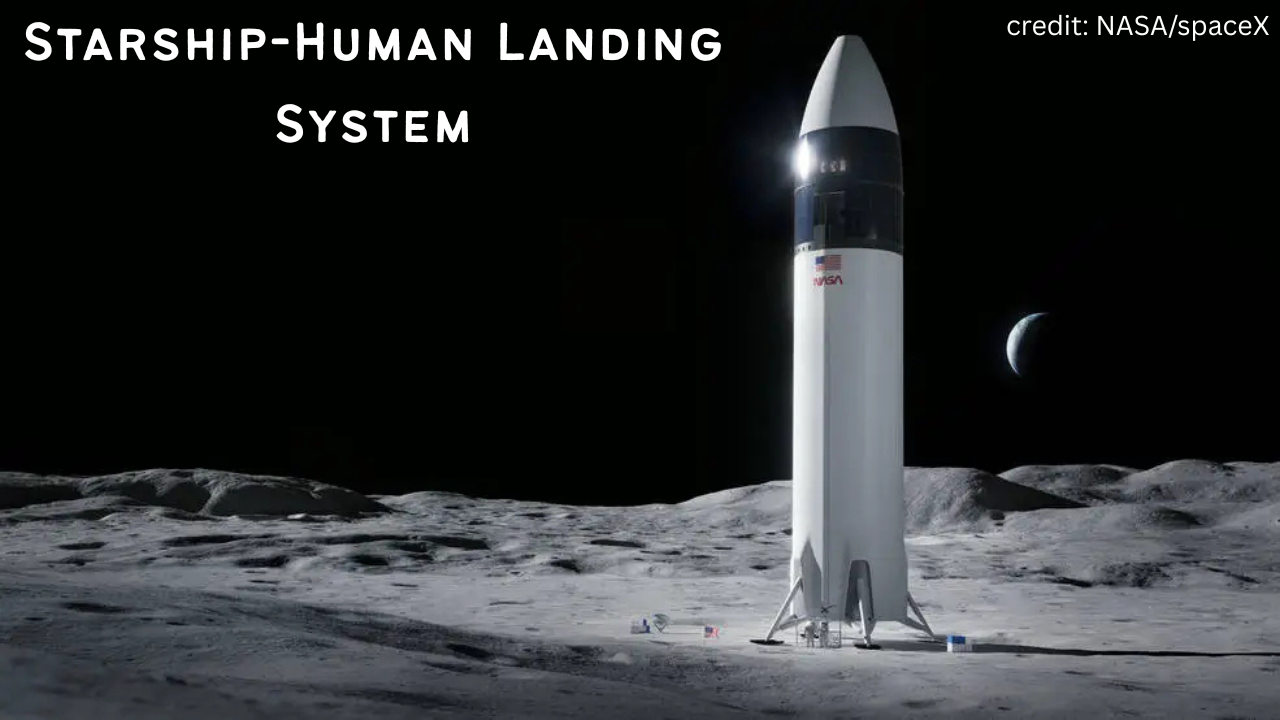
2.4 Human Landing System (HLS)
Starship-HLS
The HLS is the system (lander) that will carry astronauts from lunar orbit (or Gateway) down to the Moon’s surface, and then back up. NASA has commercial contracts for HLS development: e.g., SpaceX’s Starship HLS for Artemis III/IV, Blue Origin’s Blue Moon for later missions.
Role: key link between lunar orbit and the lunar surface.
2.5 Supporting Systems & Technologies
Though less “headline” than the four above, many other components matter for Artemis, for example:
Duration: 25 days 10 hours 53 minutes. Distance travelled: ~1.4 million miles. Re-entry speed ~ Mach 32.
Artemis II
Planned crewed mission: first crew to fly aboard Orion around the Moon (but not land).
Crew size: Four astronauts.
Duration: Approx ~10 days.
Target launch: No earlier than February 2026 (based on latest updates).
Purpose: test crewed systems, life‐support, deep space environment, human operations in lunar vicinity.
Artemis III
This will be the first crewed lunar landing of the Artemis Programme (i.e., land humans on the Moon).
Target: Land near the Moon’s south-pole region (unvisited by Apollo).
Target launch: No earlier than mid-2027 (current expectations).
Purpose: The “return to the surface” mission, employing Orion, HLS, possibly Gateway support, extensive lunar exploration.
Brief mention of future missions (IV, V…)
Artemis IV: Planned 2028 – will involve Gateway station and second landing.
Artemis V and beyond: 2030 and onward – further landings, surface infrastructure, longer stays.
4. Mission Architecture: Step-by-Step How an Artemis Mission Works
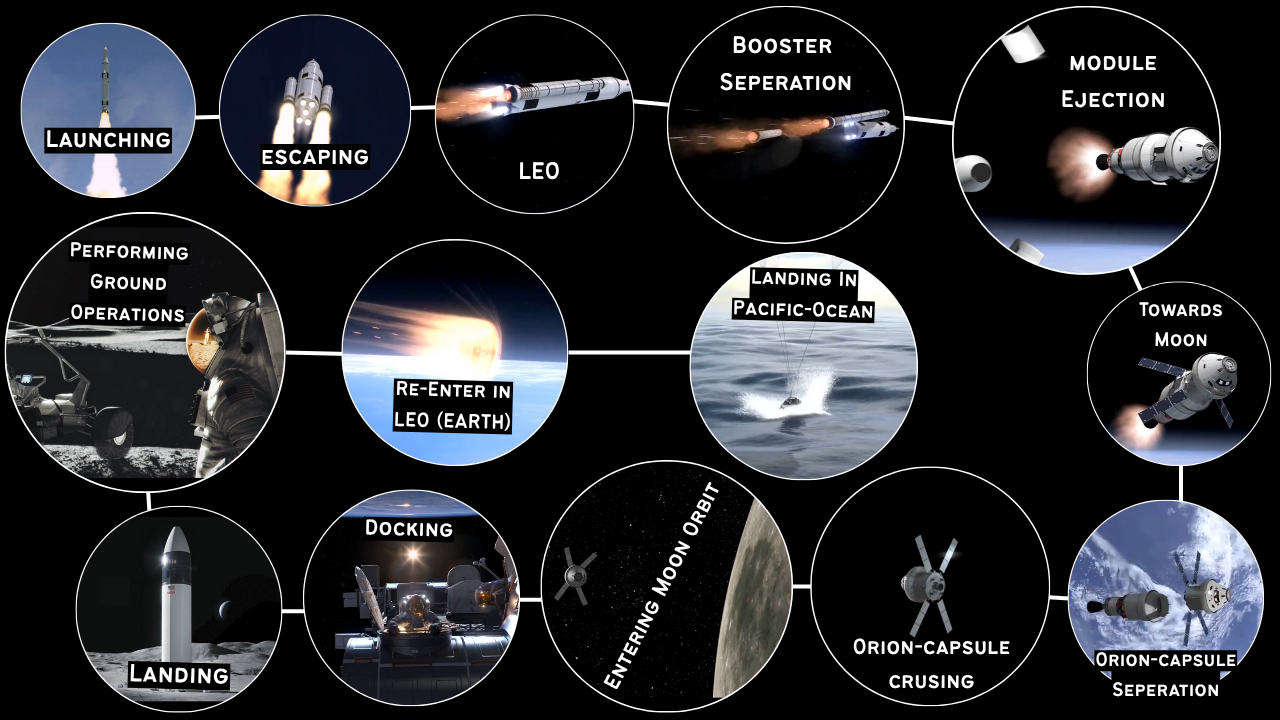
step-by-step Artemis
Below is a representative architecture of how an Artemis mission (especially those landing) progresses — from Earth launch, to lunar orbit, to lunar surface, and return. While exact steps may vary by mission version, this gives a complete picture.
4.1 Launch & Earth Departure
The mission begins with the SLS rocket launching from Earth (e.g., Kennedy Space Center, Launch Complex 39B). The Orion spacecraft (with crew or uncrewed) is perched atop the rocket. After ascent and separation of stages, Orion (and any attached elements) achieve Earth‐orbit or direct trans-lunar injection. A burn sets Orion on a trajectory toward the Moon (trans-lunar injection).
4.2 Transit and Lunar Orbit / Gateway Rendezvous
Orion travels through cislunar space, performing trajectory correction burns, checking systems. For landing missions, Orion arrives in lunar vicinity and enters lunar orbit (or rendezvous with the Lunar Gateway). If the mission architecture uses the Lunar Gateway, Orion docks with Gateway in lunar orbit (NRHO). HLS may already be docked to Gateway (or arrives separately) and is prepared for descent. Crew transfers (if needed) to the HLS (or other lander).
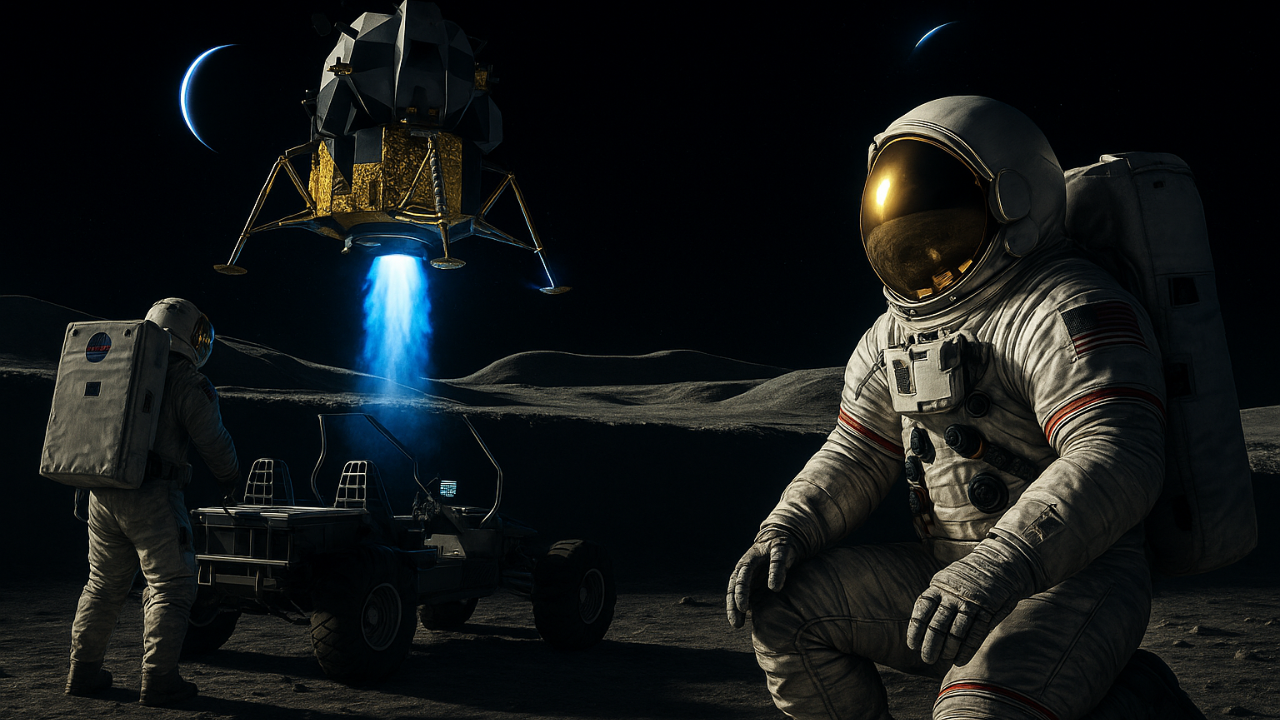
4.3 Lunar Surface Descent & Surface Operations
From lunar orbit or Gateway docking point, the lander (HLS) carries astronauts down to the lunar surface (often near the South Pole). On the surface: astronauts carry out scientific investigations, exploration, navigation, collection of samples, site investigations, maybe use of rovers or habitat modules. Duration of stay depends on mission (initial missions shorter; later missions longer).
4.4 Ascent from Moon & Return to Orion
After surface operations, the lander ascends from the Moon and rendezvous with Orion (or Gateway) in lunar orbit. Crew transfers back to Orion, the lander is left behind (or returns for reuse depending on architecture).
4.5 Return to Earth, Re-entry & Splashdown
Orion departs lunar orbit via translunar injection toward Earth. On Earth arrival: Orion re-enters atmosphere, deploys parachutes, and splashes down in designated area (e.g., Pacific Ocean). Recovery operations retrieve crew and capsule. Mission complete.
4.6 Sustainable Infrastructure & Surface Presence
Over multiple Artemis missions, lunar orbit infrastructure (Gateway) is assembled, surface habitats are deployed, rovers and logistics systems are delivered. The cycle repeats: launch → lunar orbit/station → surface → return → repeat. The aim is increased frequency, longer durations, more surface systems, and paving the way to Mars. Each mission builds upon the last: test (Artemis I) → crewed flyby (Artemis II) → landing (Artemis III) → gateway assembly/expansion (Artemis IV etc) → sustained presence.
5. Important Additional Notes & Key Points
The Artemis Programme is not a simple repeat of Apollo: the duration, goal, and architecture are far more ambitious (sustained presence rather than brief visits).
International and commercial partnerships are deeply integrated: beyond NASA, agencies like ESA, Canadian, Japanese, others are involved. Commercial firms build landers, supply services.
The lunar South Pole is a key focus: the presence of water ice, permanently shadowed regions and new science make it a high‐priority target.
The Artemis missions serve as stepping stones for deep space exploration – Mars is a long-term destination.
Technology advancement is central: new rockets, spacecraft, deep-space habitation, life support, lunar surface systems all need to mature.
Sustainability and lunar economy: part of the vision is developing lunar infrastructure, utilizing lunar resources (in-situ), and building a cislunar economy (commercial corridors, continuous presence).
6. Conclusion
The Artemis Programme represents perhaps the most ambitious human space-exploration initiative since Apollo: returning humans to the Moon, building a lasting presence, pushing technology, science and human frontiers, and setting the stage for Mars and beyond. With key components like the SLS, Orion, Gateway and HLS in place, and with a mission timeline progressing from uncrewed tests to crewed flyby to crewed landings, Artemis is charting the roadmap for the next era of lunar and deep-space exploration.
The Artemis Program: Humanity's Return to the Moon - Goals, Timeline & Components | StarzzSpace

.png)