A deep dive into the 29.5-day lunar cycle, from new moon to full moon and back. Explore the science behind the phases, their effect on Earth's tides, and the truth behind lunar myths.
For thousands of years, humanity has watched the Moon transform from a delicate silver crescent to a brilliant glowing orb and back again. This timeless rhythm, known as the lunar cycle, represents one of the most reliable and beautiful phenomena in our sky. While ancient cultures wove myths around these changes, modern science reveals an elegant celestial dance between the Earth, Moon, and Sun—a 29.5-day performance that influences our world in profound ways.
This complete guide explores the intricate mechanics behind the Moon's changing appearance, detailing each phase with scientific precision while separating evidence-based facts from popular fiction about the Moon's influence on our lives.
What Exactly Is the Lunar Cycle?
The lunar cycle, technically called the synodic month, is the 29.53-day period from one New Moon to the next. This is different from the Moon's orbital period around Earth (27.3 days) because both celestial bodies are moving around the Sun. The Moon must 'catch up' to realign with both the Earth and Sun, creating the slightly longer cycle we observe from our planet.
This cycle represents the changing visibility of the Sun's reflected light from the Moon's surface as seen from Earth. The Moon produces no light of its own; the shimmering glow we see is entirely sunlight bouncing off its rocky surface.
The Geometry Behind the Phases
The Moon's phases are determined by the changing angles between the Earth, Moon, and Sun. As the Moon orbits Earth, different portions of its sunlit hemisphere become visible to us.
The Moon's orbit is tilted approximately 5° relative to Earth's orbit around the Sun. This slight tilt is crucial—it's why we don't experience solar and lunar eclipses every month, as the Moon's shadow usually passes above or below Earth, and Earth's shadow typically misses the Moon.
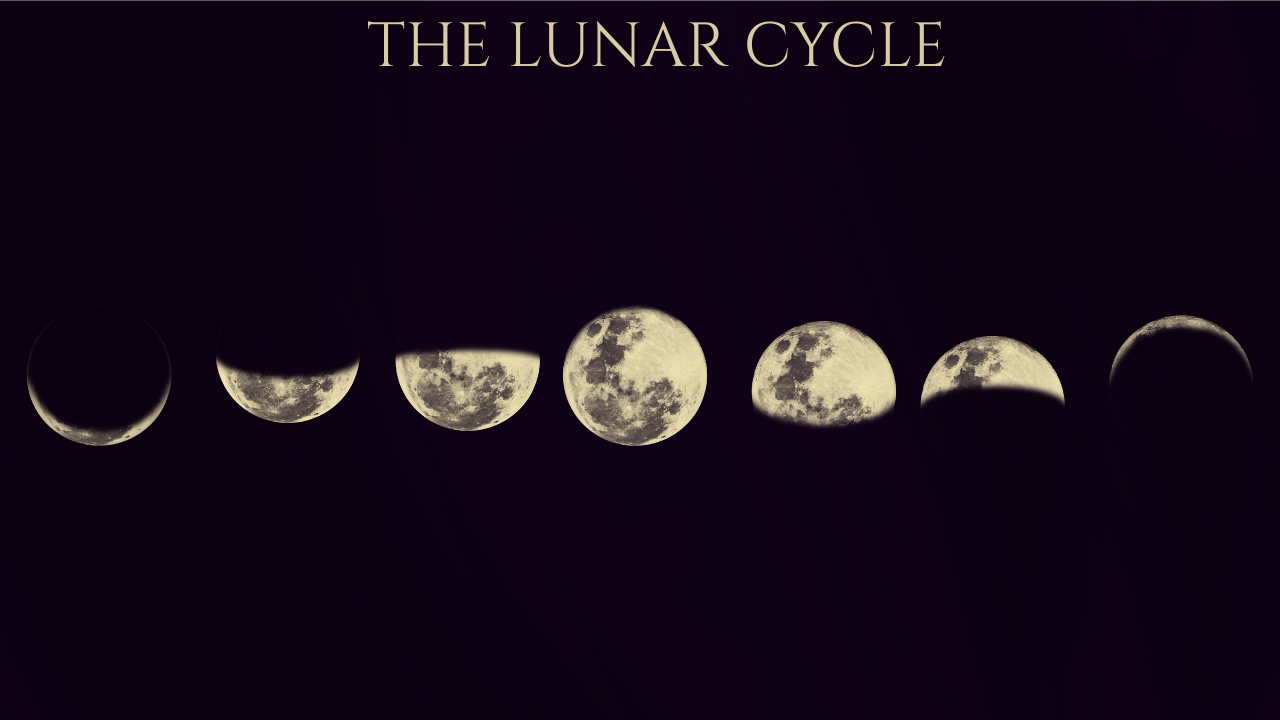
The Eight Phases of the Moon: A Detailed Journey
While the lunar cycle is continuous, astronomers traditionally divide it into eight distinct phases, each with unique characteristics and viewing conditions.
🌑 New Moon: The Invisible Beginning
During the New Moon, our natural satellite sits between Earth and the Sun. The illuminated half faces away from us, rendering the Moon virtually invisible against the daytime sky. This phase represents both an ending and a beginning in the lunar cycle.
When perfect alignment occurs despite the orbital tilt, the Moon's shadow can touch Earth, creating a spectacular solar eclipse. For astronomers and stargazers, the New Moon's dark skies offer perfect conditions for observing distant galaxies and faint nebulae.
🌒 Waxing Crescent: The First Glimmer
waxing crescent
As the Moon moves along its orbit, a slender crescent emerges—the first visible evidence of the new cycle. In the Northern Hemisphere, this delicate sliver appears on the right side, growing thicker each evening as 'waxing' continues.
A fascinating phenomenon called 'Earthshine' often appears during this phase, where the dark portion of the Moon glows faintly from sunlight reflected off Earth's oceans and clouds. Leonardo da Vinci first correctly explained this 'ashen glow' over 500 years ago.
🌓 First Quarter: The Perfect Half
half moon
Despite its name, the First Quarter Moon shows half of the Moon's Earth-facing side illuminated. The term 'quarter' refers to the Moon completing one-quarter of its orbital cycle around Earth. This phase creates dramatic shadows along the 'terminator' line—the boundary between light and dark—making it a favorite among lunar observers with telescopes.
🌔 Waxing Gibbous: Nearly There
waxing gibbous
The 'gibbous' phase (from the Latin for 'hump-backed') shows a Moon that's more than half illuminated but not yet full. The bright portion continues to expand, dominating the nighttime sky and providing increasingly abundant moonlight.
🌕 Full Moon: The Celestial Spotlight
full moon
When the Moon reaches opposition—with Earth directly between it and the Sun—the entire Earth-facing side becomes illuminated. The Full Moon rises as the Sun sets, creating the brightest nights of the lunar cycle.
When the Full Moon coincides with its closest approach to Earth (perigee), we experience a 'supermoon' that appears slightly larger and brighter. Conversely, when perfect alignment occurs during this phase, the Moon can pass through Earth's shadow, creating a lunar eclipse.
🌖 The Waning Gibbous: A Gradual Farewell
waning gibbous
“Waning” means the illuminated portion is shrinking. Light now appears on the left side. The Moon moves away from full illumination, but more than half remains visible. After the Full Moon, the cycle reverses through the Waning Gibbous, Last Quarter, and finally Waning Crescent phases. The illuminated portion steadily shrinks ('wanes'), with light now appearing on the left side (in the Northern Hemisphere) until the Moon returns to New Moon and the cycle begins anew.
🌗 Last Quarter: Left half of the Moon illuminated
half moon
Half of the Moon is lit again, but this time the left side. The Moon has now completed three-quarters of its cycle. Tides again shift due to the gravitational angles.
🌘 Waning Crescent
waning crescent
The Moon approaches the final stage of its cycle. Only a small sliver remains illuminated. Soon the Moon re-enters the New Moon phase and the cycle restarts.
The Moon's Proven Effects on Earth
The lunar cycle exerts measurable influences on our planet, with ocean tides being the most obvious example.
Spring Tides: During New and Full Moons, when Sun, Earth, and Moon align, their gravitational pulls combine to create higher high tides and lower low tides.
Neap Tides: During Quarter Moons, when the Sun and Moon pull at right angles, their forces partially cancel out, resulting in less extreme tidal ranges.
Beyond tides, the Moon plays a crucial role in stabilizing Earth's axial tilt. Without our relatively large natural satellite, Earth's tilt could vary chaotically over time, causing dramatic climate shifts that would make complex life much more difficult to sustain.
The Moon and Human Behavior: Science vs. Myth
Despite persistent folklore, extensive scientific research has failed to find convincing evidence linking the lunar cycle to human behavior patterns.
No correlation with mental health episodes, crime rates, or birth frequencies
Some studies suggest minor sleep pattern disruptions during Full Moons, possibly due to increased brightness
Animal behavior changes are typically related to moonlight availability rather than 'lunar influence'
The term 'lunatic' derives from the historical belief in lunar effects on mental health, but modern statistical analysis of hospital admissions and crime data shows no meaningful patterns correlated with moon phases.
The Moon's Slow Farewell
Our celestial companion is gradually drifting away from Earth at approximately 3.8 centimeters per year—about the same speed your fingernails grow. This slow retreat, measured precisely by laser reflectors left by Apollo astronauts, has profound long-term implications.
Over hundreds of millions of years, this lunar migration will lengthen Earth's day, eventually making the lunar cycle longer. While these changes occur too slowly to affect human civilization, they represent the dynamic, evolving nature of the Earth-Moon system.
Conclusion: A Timeless Cosmic Rhythm
The lunar cycle represents one of the most reliable and observable celestial phenomena—a perfect demonstration of orbital mechanics that connects us to the cosmic dance of our solar system. From governing ocean tides to inspiring art and literature, the Moon's monthly journey continues to captivate, even as science reveals the elegant mechanics behind its changing face.
Whether you're a casual observer enjoying a Full Moon's glow or an amateur astronomer tracking the terminator's progress across lunar craters, understanding the science behind the phases only deepens the appreciation for our planet's constant companion in space.

.png)
.png)
.png)
.png)
.png)
.png)
.png)
.png)
.png)